May 13th, 2008

I opened up my email early this morning to find a message from Australia about a new publication called Kurungabaa. The email was short but direct. It’s main purpose? To introduce Kurungabaa, a “journal of literature, history and ideas for surfers.” I replied that I would take a look and went on about my morning rituals.

australian pelicansThroughout the course of the day I read several of the sample entries, stealing time at work in between email and paper shuffling. At the moment I am moved infinitely by some of the thoughts I came across. I feel like anything I may say about the publication will be too little, as my own abilities to pound on these keys and get a clear point across in a way that contains both style and integrity is still eons away, if it ever reaches me at all. But what passes across my vision on the online version of the freshman text is anything but amateur.

The journal’s editorial mandate is to provide a platform for commercial free content, produced by established as well as rising surfer authors, poets, artists and of course photographers. The first issue has a fiery introduction written by Tim Baker in which he challenges surf magazine editors worldwide to have some integrity in a time when editorial content is strictly driven by advertising dollars. But it’s not all serious business here. There is humour by the bundle. Being new to Aussie surf writing, I was surprised and fully inspired by the looseness and freedom with which writer DC Green expresses himself. And there’s still a tone I’ve yet to read! Please be sure to visit the site for more information. And if you are a writer check out the contributor section.

We can be certain that the surfing collective is not sitting on its laurels these days. As surfers we can purchase locally made boards made from more earth friendly materials, we can get non-petrol based surf wax, and even high quality, commercial free surf writing. It’s a good time to live simple and pursue a life of surf, even if we are in the midst of rampant consumerism. Give Kurungabaa a read, get stoked, go surf.

Posted in art, news & media, phoresia.org | No Comments

May 5th, 2008

So we’ve been slacking a bit on content lately, but not without good reason. The biggest reason being the birth of my baby girl last week. All is good and we are stoked on the latest addition to the quiver.

Little girl
Dims: 19.5″ x 7 lb. 14 oz.
Definitely a “small-wave” model, notice the adjustable, accelerated tail rocker. Unique design feature.

Another factor in the lowered post count has been the unusually consistent surf we’ve been having on the East Coast and on top of that a couple new boards to try out -one being the Bonzer in the post below, and the other being a stringer-less EPS/epoxy board which we’ll be doing a write-up on in the near future. Ricardo has a Biofoam Bonzer that should be at his door any day now for the nice points up in the Maritimes. I got a sick new hemp boardbag and recycled leash from WaveTribe, so look for a write-up on those coming soon as well.

There are lot of new products out there that are less harmful to the environment, which seems to point to the fact that the “going green” movement has reached a tipping point now where it is passing over into mainstream business. You now when there are surf industry business seminars for going green, that producing less harmful product has hit the manufacturers where it counts, in their bottom line. Companies realize it’s a growing market and people are demanding greener product and if they can’t deliver, someone else can. Again, to re-iterate our often repeated message, support the companies that support the environment. It will only help to push other companies to re-evaluate their positions or risk losing market share.

Most of the green washing seems to be going down on the softgoods side of things, whereas the place where it counts, the reason why we live our lives the way we do, is seeing some real tangible improvements. I’ve been using some soy-based wax from Magma that’s been working killer and also heard some rumors about some track pads sourced from more friendly materials. Just a couple more pieces in the pie toward having a complete setup that is just that much less harmful to our surroundings.

Summertime is just around the corner, so with the lack of waves, hopefully we’ll have a bit more time to get focused back on Phoresia. In the meantime, we’ll be out surfing and cruisin around on our bikes.

Posted in board construction, industry, phoresia.org | 10 Comments

April 21st, 2008

I’ve had my Ice Nine Bonzer for a couple months now but we had a stretch of terrible waves. And then we got one of the best swells we’ve had all year and the night before my shaper dropped off a new stringerless EPS board that I’ve been waiting on for quite a while. So sadly the Bonzer has been sitting neglected in the racks without its fins even being installed and no wax.

Neilson 6′2″ Bonzer

Needless to say, the constant barrage of Bonzer-porn that gets posted over at SurfySurfy really had me wanting to try one out for myself to see what they are all about. I’ve wanted to get a Bonzer for quite a few years now, but have been trying to get my quiver dialed in so I never had all my boards perfect where I had room to experiment. I was always refining and updating shapes, trying to get all my boards to work well in the wave conditions they were intended for. Then several moths ago we received a couple of plant-based Ice Nine blanks to try out for Phoresia and figured a Bonzer would be a perfect experiment for one of the blanks. I picked the brain of my long-time shaper, Tom Neilson, and finally settled on a 6′2″ round-tail outline that he already had pretty diealed and had good feedback on from his team riders.

The Ice Nine blank shaped up well but there were some issues with the glassing. Ice Nice has the process dialed in but it requires following a rigid set of instructions to prevent overheating the blank during the glassing process. This board was airbrushed solid yellow as well, so there could have possibly been a reaction with the paint, but the end result left air bubbles in the glassjob. The flaws were mostly cosmetic but not something that could pass off in a retail environment. I wanted to ride the board a couple times before I gave a solid review of it to see if there would be any problems aside from the aesthetics.

Well I finally got the first sessions in on it this past weekend. To make a long story short, I was blown away. Friday after work I took the Bonzer out in some head-high junky beachbreak. Right away I could tell I was going to like it. It paddled how one of my favorite small wave boards paddled and just felt connected. The first wave I took off on I had no idea what to expect and was pleasantly suprised by the speed and looseness of the board. I guess I had preconceived notions of it riding more like a single than a thruster but it’s a unique feel all it’s own. Loose but not like it’s going to slide out, it felt engaged but went rail to rail quickly and easily. With so much new design going on under my feet it was hard to tell what was contributing to the overall ride but I had a great session, caught a ton of waves, and was feeling really confident on the board. Not much more you can ask for out of a board on the first go out.

Neilson 6′2 Bonzer Deck/BottomSaturday morning the waves had dropped in size a bit but it was clean with a full tide. I took it out again to see how it would work in smaller surf that required a bit more effort to produce speed. Again, pleasantly surprised. I made some really fast little sections and it felt good on waist high bowly waves. All in all I’m super stoked on the combination. After two sessions I’ve got a minor heel dent from my front foot, but that’s it. No other pressure dents which is surprising considering the abuse I dished out to the board on Friday’s shore pound session.

The feedback on these blanks has been similar to that of the Biofoam boards. They tend to hold up better to compression dents and can be glassed a little lighter than an average poly board. The board is glassed with 6/6 oz. on the deck and 6 oz. bottom and poly UV resin. With the five fin boxes it’s no lightweight but I don’t mind trading a little weight for the added durability.

As far as the Ice Nine blank goes, it’s a viable alternative, but it does require some added attention during the glassing process. I’ll have to wait and see how the longterm durability is to make up my mind about it. It’s interesting though that in the past month I’ve ridden boards made of standard poly, biofoam/epoxy, IceNine/UV poly, EPS/epoxy, and a stringerless EPS/epoxy board. All were locally shaped and glassed. The alternatives in materials are definitely out there if you are willing to search them out and ask for them. Try it, you just may like it.

Posted in board construction, industry | 5 Comments

April 13th, 2008

Today’s post is about longevity and the concept of quality in craftsmanship. There is an added benefit when acquiring a tool that is well made to last for years of use. That benefit is familiarity. ricksfish3.jpgWhen we use something over and over again, and it is a tool that by design fits our needs and temperament proper, then we develop a very close understanding to the working of said object and after a while we can master it.

Such is the case with a well-made custom surfboard. In my case I am referring to my year old Tom Neilson Shapes “Flying Floatey Fish” - as Tom dubs them. This board being the second one of its design that I have owned. The first one I sold prematurely in order to help fund a cross country move a few years ago. But the current green machine was made specifically for my needs in the Canadian Maritimes. And so far, it has withstood the test of time with little to no scaring and many hours in the water.

Rick’s Flying Floatey FishA year ago I had this to say:

“Surfboard fit is not a mystery. I recently got a new board shaped. I called my shaper and talked to him briefly about what kind of surfing I wanted to do. I was interested in catching waves and having speed above manoeuvrability. I wanted to focus more on making sections and catching waves than top to bottom surfing. He suggested a plan shape. Next I told him how much I weighed (and I was honest) and that most of the year I wear a 6mm suit with 7mm mitts and booties. I sent my down payment and the shaping began.”

And the prognosis? Well I’m an average surfer at best. But having a board that is built for my needs has had a tremendous impact in both my skill level and wave count. So much so that that two of my friends have recently ordered their own Neilson fishes. So while I have not mastered my green machine yet, I have come to know it’s curves, it’s place under my chest as I paddle, its ability to take off late, its arc in turns going backside, its range of wave preference, and most of all its feel. Rick’s Flying Floatey FishGetting a feel for a board is so important, although most could agree on this matter, few could be articulate about it – including yours truly.

So if you’re in the market for a new board consider a handmade and hand glassed EPS and Epoxy construction board. Talk to your local shaper about your needs and wants in your surfing and take the risk of trying something new. But remember, unless you’re a “freak,” expect that any new board will take a little getting used to and in time will pay off in smiles and maybe even a little cover-up.

Posted in board construction, industry, labor issues | 5 Comments

April 7th, 2008

My mom taught me a very important lesson back when I was in middle school. It wasn’t one of those life altering experiences or epiphanies that change your world-view, but more of a slow creeping note that kept
resonating throughout my life as I grew older and began to evaluate my purchases more. The lesson in question was one of those childhood fads, where you feel that your status in the social order is hinging upon whether or not your parents agree to purchase some ridiculously overpriced childhood whim. Parachute pants - Rockin’ it 80’s stylieThe object of my affection - parachute pants. My mom explained it to me like this, I could buy 1 pair of parachute pants or 3 pairs of regular good old fashioned denim jeans. But if I got the parachute pants, they would have to replace the cost equivalent 3 pairs of jeans, which meant I’d be rocking the zippers non-stop. At the time, this was a no-brainer, I’d rock that shit with pride clinging to my status on the 4th grade social pecking order. I saw it as a win-win. So, needless to say I rocked the grey zippered parachute pants non-stop for quite some time. My mom explained it to me as cost-per-use. Sometimes things that seem excessively expensive compared to similarly comparable products, say a pair of parachute pants versus a pair of denim jeans, actually work out to be cheaper in the long run once you factor in the cost-per-use over their entire lifecycle.

I find myself evaluating this cost-per-use value method almost daily in my adult life. When I’m making purchases I think of how often I will use the product and that usually dictates what price range I’m willing to spend. If it’s something I’ll use daily or on a regular basis, I’m much more willing to spend more money or a better product because it will work out to be less money than buying a cheaper, less quality product that gives you hassles or doesn’t last as long. You have to take into account the usage and the effective lifespan of the product.

What the hell does this have to do with surfing you ask?

5'10 Neilson QuadI was going through some pictures the other day and came across a shot from nearly 3 years ago. I was riding a board that I still have and still ride on a regular basis. It’s a little 5′10″ x 21″ quad with small waves in mind. Seeing as I live in Florida and it’s rarely over head high, this board sees a LOT of water time. It’s nothing fancy, a Clark green blank with a 6/6/6 poly glassjob and a speed finish. I’d have to think that by now the cost-per-use on this thing is probably down in the pennies-per-wave range. My mom would be extremely happy about this purchase. Just another reason to get a board from your local shaper.

Posted in board construction, definitions, phoresia.org | No Comments

March 31st, 2008

We’ve spent quite a bit of time lately talking about the “essence of surfing.” What is the essence of surfing? Is there even such a measurable thing? The truth is that the essence of surfing is simply a concept, an ideal shared by the surfing collective but manifesting itself to each individual in myriad ways. Maybe it’s easier to see what the essence of surfing is not. But rather than go into such a possibly bleak discussion its probably best to look at one very keen example of this essence by way of a soon to be released film titled Musica Surfica.

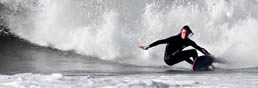
Musica Surfica - HeathWritten and directed by Mick Sowry, Musica Surfica is unlike any surf film you’ve ever seen before. The concept is the marriage of classical music and finless surfing into a new manifestation of art with roots as far back as anyone can trace. The film combines elements of ancient surfing and modern surfboard designs with ancient instruments and new approaches to playing classical music. Sounds strange? Perhaps, but the results are inspirational and certainly at the height of the art of surfing. A group of surfers, led by the stylish and talented Derek Hynd, go to King Island, Australia and spend a week riding a variety of finless surfboards. One of the members of the group is Richard Tognetti, artistic director for the Australian Chamber Orchestra and an accomplished surfer. Hynd and Tognetti came up with the idea of collaborating on a film project that would expand the boundaries of music and surfing. For Derek this meant introducing others to riding without fins, something he has learned to do quite well. And for Tognetti the project allowed him to step out of the walls of the sometimes ultra-traditional classical music world to include other forms of music and less traditional venues. Musica Surfica - DerekDerek Hynd says in the film that his “passion is investigating the unknown.” It’s evident in the way that Hynd slides and spins in and out the critical sections of the wave that he has seen the unknown and may be even coming out the other side. As for the music, just a look on the faces of the spectators is enough to make one smile, let alone the seeing the blinding speed and precision with which Tognetti plays his instrument.

After watching the film several times I am left with an overall feeling of inspiration to continue along the path of dedicating my time to pursuing surf. This may indeed be the most striking aspect of Musica Surfica. Tognetti states that surfing is “about the celebration of the individual.” Removing the fins has forced surfers like Tom Carroll to re-evaluate his relationship to the ocean and rely strictly on his ability to become part of the energy moving across space. Without fins, the activity becomes all encompassing with all attention focused on the slide. The same happens with the performers and audience –a complete and undivided attention. And the surfing? In the beginning of the film the surfers are struggling to make the finless craft work but they quickly progress through the film. However, in the end, we are treated to a spectacle never seen at most of our local breaks. Derek Hynd, spinning madly in and out of barrels, crouched as if ready to spring, ready to burst with power, and yet keeping cool, collected and in complete control. And then as if we still weren’t sure about the whole fins free thing, we see footage of Hynd surfing J-Bay like he did in Litmus, except this time it’s finless and flawless.

Musica Surfica - Richard TognettiMusica Surfica is about finless surfing and live music. But it is also about our individual relationship to the act of surfing and how our passion is connected to the past. The film also dares us to be open to new possibilities and new challenges both in and out of the water, to be adventurous and courageous even if it means that we don’t hit the lip as we’d like. As for exploring the essence of surfing, there’s plenty to ponder in this beautiful film which I gaurantee you will watch over and over again.

Watch the Trailer for Musica Surfica:

Thanks to Mr. Sowry for sending us an advanced screening copy. For more information please visit Mick’s blog:

http://safetosea.blogspot.com

Posted in art, board construction, news & media, travel | 4 Comments

March 18th, 2008

It’s not often that a surf film documents rather than simply portray the surfing lifestyle. Under the Sun is such an example. Filmed, edited, and written by filmmaker Cyrus Sutton, Under the Sun takes an in depth look at two Australian cities that have shaped our current, and sometimes clashing, duality of surfing cultures. There’s the Gold Coast, boasting major surf wear multi-nationals and home to some of the best competitive surfers in the world. And down the road a ways there’s Byron Bay, perhaps best known from early on in the Morning of the Earth, a hippie enclave with locally grown foods and simple living. But Sutton does much more than compare the two cities. In fact, Sutton manages to objectively look at the commodification of modern surf culture, as it exists in both the competitive and “free surfing” world.

Under the Sun - poster

But there is much more to the well executed film. The cinematography and composition are flawless. Sutton provides as much eye candy and he does interview footage. I am no surf historian and cannot vouch for the history laid out in the film, no matter anyway as history is hardly static, especially in surfing. Sutton interviews a broad cast of characters to bring home the bacon. From Rabbit to Dean Morrison and the old Tracks Magazine crew, to Nat and Beau Young and David Rastovich, we see various view points about the controversial subject – is surfing sport? And in true documentary form, Sutton leaves this question up to the viewer to decide.

Cyrus Sutton - 5 overIf you’ve read the latest issue of The Surfers Journal you know that Sutton has had a tough time making this film. He had all of his camera gear stolen –twice! However, his perseverance pays off in the end. The film weaves in and out through time showing us the progression of surfing as well as the progression of the surf industry. Nonetheless, Sutton ends the film with the average surfer in mind. He reminds us why surfing is important and why we devote our lives to it. And in some ways it makes me feel grateful that surfing is not how I make a living. It makes me happy that surfing is a complete distraction from daily life, a distraction that is at once life fulfilling and even spiritual. In a moment of clarity David Rastovich makes a statement that defines and perhaps validates, the selfish pursuit of surfing. David RastovichRastovich wonders out loud about the value of spending his life chasing waves and comes up with a simple self-evident truth. He states, “the joy of the environment is what we’re here for.”

We do not choose where we’re born or what social class we belong to. For those of us lucky enough to pursue surfing as a life long passion, Rastovich’s statement holds a whole heap of meaning. Why wouldn’t we derive joy from our environment? Is it not our responsibility?

Under the Sun is a great film and nothing less. Thanks Cyrus for allowing us to screen it.

For more info please visit:
www.underthesunsurfmovie.com

Check out the trailer for Under the Sun here:
www.youtube.com/watch?v=S7qHrBWyBVc

Posted in art, fashion, industry, interviews | 7 Comments

March 3rd, 2008

I stumbled upon a thread on a Florida surfing forum recently where the topic was a heated discussion about the value of the current popular surfing publications. The author of the thread had this to say:

“So they finally lost me. After at least ten years of signing back up I’m over it. All the f’n adds, repeated destinations, same lame interview with the “Next Kelly” and articles geared to sell product. They both truly lost me with the pro Made in China articles.Surf Magazine Subscriptions One mag while proudly boasting “Shaper of the Year” wasted good recycled pulp and ink to show case a highly talented group of shaper/surfers only to have them riding and talking about boards that were constructed by a faceless, under paid Asian. The other mag stole some quality “me” time trying to convince me that “Hey you should thank the companies who took their factories over seas cause even though none of them surf now they do get waves.” Of course I’m paraphrasing. So it looks to me like they have an agenda that I can no longer support. What happened to the soul, the craft, the innovation? Can we no longer get it from our own back yard. For Christ sake there is a two page add for Joel’s Good Karma line brought to you by the pop-out kings themselves. Has Joel sold his “soul”? Gotta go They’re watching me…………..” - Click here for the full context of the forum thread…

This sparked a long rumination in my brain about sustainability and the balance between profit and integrity. OK, I know that last sentence was a bit out in the flats so I’ll clarify. What is the role of a magazine like Surfing or Surfer? Presumably the role is twofold: to provide their readers with insightful and original content about surfing, surf culture, surfboard design and competition, and to make revenue from advertising. After all, any business initiative has to make money or it dies without the world noticing. What seems to be happening however, and this doesn’t strictly apply to surfing magazines, is that profit from advertising is controlling much of the space in the magazines as well as the content.

Surf MagazineIt’s hard to say whether these publications will die. In fact, it’s unlikely. Their subscription rates are so low these days that you wonder if what you pay for years’ worth even covers shipping. This means that they must me making a killing off of advertising. But what happens if no one wants to buy the magazine? Advertisers will take note. In reality this scenario is at the extreme end of what is possible. And recently one of the editors for a major surf magazine has been posting comments on Swaylocks, and he’s received quite a bit of flack too for his editorial direction. But the fact that he’s willing to risk his neck on Swaylocks shows an interest in being in touch with people who surf. It also shows promise that the magazine will at least be in touch with what the actual surfing public is interested in.

The principles of sustainability apply to all aspects of modern life. And culture magazines are no exception. If a publication is to survive, and if it cares at all for preserving some journalistic integrity and an honest look into the culture, then it must have a strict balance between advertising revenue and the needs of its readership. This is not rocket science nor as controversial as quad fin placement. For now we can all be thankful for the ever growing community of surf bloggers from all over the world. Blogs like Surfy Surfy, SissyFish, Warbles, Surf in Oregon, Contra Ola, Safe to Sea, Wine and Woodsmoke and The Fresh Aspect bring  fresh and commercial free content to our surfing collective. Thanks to all of you for your hard work. It’s interesting thing to read various surf blogs throughout the world and hear first hand about things that are going on in the surfing world outside of the ASP and the next “whosit” supergrom -things that are never mentioned in the major surf publications, yet are more at the heart of what the average magazine buying surfer is interested in.

Mahalo

Posted in industry, news & media, phoresia.org | 15 Comments

Navigation

Archives

Meta